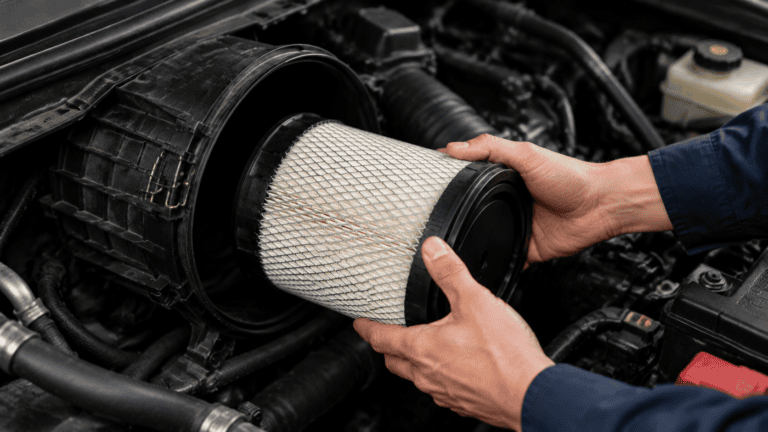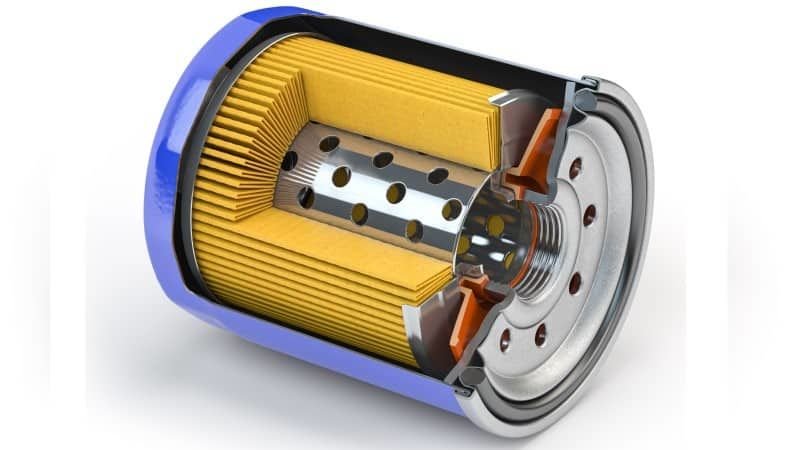
A truck engine needs a lot of clean air, and every air filter gets in the way of that air a little. The resistance it adds is called restriction. When truck air filter restriction rises too high, the engine has to work harder to pull in air, which can mean less power, more smoke and higher fuel use. This guide explains what truck air filter restriction is, what makes it climb, how the filter paper, pleat count, filter area and construction affect it, and how to tell when the filter needs replacing.
What Is Truck Air Filter Restriction?
Truck air filter restriction is the resistance the air cleaner puts up against the air flowing into the engine. As the filter collects dust, the vacuum on the engine side of the air cleaner increases, and that vacuum is measured as restriction. It is usually shown in inches of water column (in H2O) or in kilopascals (kPa). One psi is roughly 27.7 inches of water, which is why such a small unit is used for these small pressures.
Restriction is not one fixed number. It changes with:
- Airflow: it is highest at full load and governed rpm, when the engine pulls the most air.
- Filter condition: a new filter starts low and rises as it loads with dust.
- The rest of the intake system: the housing, ducting, pre-cleaner and turbocharger inlet all add their own resistance.
Because of this, the baseline reading differs from one truck to the next. A clean filter often starts somewhere in single digits to low teens of inches of water, depending on the engine and the length and diameter of the intake tube.
What Is a Normal and a Maximum Restriction Level?
Engine makers set a maximum allowable restriction, and the filter should be replaced when it reaches that limit. Published limits differ by engine:
- A service bulletin for filter maintenance notes that most engine makers suggest 20 to 30 inches of water for diesels.
- A Daimler Trucks service bulletin tells technicians to replace the air filter at 25 inH2O for diesel engines, or at the 12-month mark.
- An older equipment manual lists a lower limit for one Cummins engine (20 inches) and a higher one for a Caterpillar engine (30 inches), which shows how much the limits can vary.
The takeaway: do not use one number for every truck. Use the limit published by the engine maker for your engine, and set your restriction indicator to match.
The same Daimler bulletin also warns that a very low indicator reading (0 to 4 inH2O) can point to an air intake problem, such as a damaged filter, loose or disconnected intake piping or a disconnected indicator. In other words, low restriction is not always good news.
7 Causes of High Truck Air Filter Restriction
1. Normal Dust Loading
The most common cause is simply that the filter is full. Every particle the media catches blocks a little more of the pore space, so airflow gets harder as the filter loads. This is the filter doing its job. Restriction is meant to rise slowly over the service life and then climb faster as the filter nears its capacity.
2. Dusty or Harsh Operating Conditions
Trucks working on gravel roads, in quarries, on farms and on construction sites load their filters faster than trucks on clean highways. High humidity or rain can also raise restriction slightly. Heavy dust means shorter service intervals, which is why restriction should decide when to replace the filter, not the calendar alone.
3. Too Little Filter Media Area
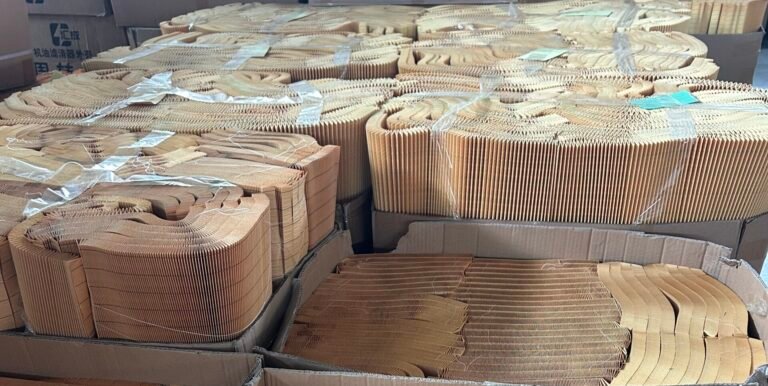
Media area is a major factor in how much resistance a pleated filter creates and how much dust it can hold. When the same airflow passes through less media, the air moves faster through each part of the media, restriction starts higher and the filter fills sooner. An undersized or cheaply made element with less media than the original can show high restriction early. This is one reason to compare height, diameter and pleat design against a reference filter and not only the part number.
4. Wrong Pleat Count or Poor Pleat Spacing
Pleats fold a large area of media into a small space, but pleat count and spacing have to be balanced. Too few pleats leave area unused, while too many crowd the pleats together so air cannot get between them and restriction rises. Patent literature on pleated filters notes that surface area is a major factor in flow resistance and loading capacity, and that when pleat tips become wavy and the pleat walls touch, parts of the media are closed off, which raises pressure drop and reduces dust holding capacity. Even, stable pleats use the whole media surface and keep restriction low.
5. Filter Paper With Low Permeability
The filter paper itself controls how easily air passes through. A dense media may catch very fine dust but pushes back hard against airflow, while an open media flows freely but lets more dust through. Good media balances efficiency, dust capacity and low restriction. Poorly controlled media, with uneven thickness or pore structure, creates weak spots and high-resistance zones. Our article on how high-quality filter paper improves truck air, oil and fuel filter performance explains what to look for.
6. Damaged, Deformed or Oil-Wet Elements
A filter can show high restriction because it has been damaged. If the media gets wet or soaked with oil or soot, its pores clog. If the pleats deform or collapse under pressure, area is lost and pressure drop rises, which puts even more force on the media. Weak center tubes, thin metal and poor adhesive bonding make collapse more likely. A dry paper element should never be oiled, and a filter that has been wet or crushed should be replaced.
7. Problems in the Rest of the Intake System
Sometimes the filter is not the problem. Blocked pre-cleaners, debris in the intake snorkel, snow or ice, a plugged dust valve, a pinched or collapsed hose, or a wrong-size housing all add restriction. Inspect the whole path from the air inlet to the turbocharger, not just the element. If a new filter still reads high, look at the ducting and the housing.
How Media, Pleats, Area and Structure Work Together
| Design factor | Effect on restriction | What to check |
|---|---|---|
| Filter paper | Controls how easily air passes through and how much dust is held | Consistent thickness, uniform pore structure, media supplier and grade |
| Pleat count | Too many pleats crowd the air path, while too few waste area | Even count compared with the reference filter |
| Pleat spacing and shape | Uneven or wavy pleats close off media and raise resistance | Straight, evenly spaced pleats from end to end |
| Media area | More area means lower air velocity through the media, lower starting restriction and more dust capacity | Height, diameter and pleat depth against the reference |
| Structure | Weak center tube, thin metal or poor bonding lets pleats collapse | End-cap bonding, glue lines, center tube strength |
| Seal | A poor seal leaks dust and causes a false low reading | Seal condition and fit in the housing |
An industry test endpoint helps put this in perspective. A radial air filter patent describes a standard dust capacity test that ends when the pressure drop across the filter reaches 25 inches of water, and it explains that a lower initial restriction gives the filter a wider pressure range before it plugs. In practice, a filter that starts lower usually has more usable life before it reaches the engine maker’s limit.
Air filters can be compared using the ISO 5011 test method, which measures airflow restriction, dust collection efficiency and dust capacity. Ask for test data if you buy truck air filters in volume. Our guide on how to evaluate truck filter samples before a bulk order explains how to check the build quality and performance of samples.
How to Tell When a Truck Air Filter Needs Replacing
Do not guess from the look of the filter. Donaldson advises that air filter service life should be determined by measuring airflow restriction, not by visual inspection alone, and that the filter should be changed when restriction reaches the engine maker’s maximum. Use this approach:
- Check the restriction indicator. Many trucks have a dash gauge or a latching indicator on the air cleaner or intake pipe. Read it after running at full load, because the indicator holds the peak reading.
- Know your limit. Replace the filter when the indicator reaches the engine maker’s maximum, often around 20 to 25 inches of water for turbocharged diesels.
- Reset the indicator after every service, and test that it works, since a faulty indicator gives false readings.
- Watch for a sudden jump. A sharp rise in restriction can signal wet media, a collapsed element or a blocked intake path.
- Inspect the element for tears, crushed pleats, oil contamination, a damaged seal or dust on the clean side. Any of these means replacement, whatever the gauge says.
- Look for symptoms. Loss of power, black smoke and higher fuel use can all indicate restriction. Fleetguard also describes blocked filters as a stress on the air induction system that can reduce fuel economy or power.
- Follow time limits. Some engine makers also set a replacement interval, such as one year, even if the gauge has not reached its limit.
A dirty-looking filter is not necessarily a spent one. Fleet maintenance writers report that elements that look very dirty may still have life according to the indicator, while a clean-looking one can have hidden damage. The gauge and a proper inspection together tell you more than appearance.
Common Mistakes With Truck Air Filter Restriction
- Changing filters by the calendar only, which wastes good filters in clean conditions and risks overload in dusty ones.
- Using the wrong limit, because one engine’s maximum is not another’s.
- Ignoring a very low reading, which can mean a leak or damaged element.
- Fitting a filter with less media area or poor pleats, just because it has the right part number.
- Cleaning or oiling a dry paper element.
- Skipping the intake system, when the real restriction is in the ducting or pre-cleaner.
- Forgetting to reset the indicator after a filter change.
FAQ
Q: What is a normal truck air filter restriction?
A: It depends on the engine and the intake system. A clean filter usually reads well below the engine maker’s limit, and the maximum is often 20 to 25 inches of water for turbocharged diesels. Check the limit published for your engine.
Q: Can a new air filter have high restriction?
A: Yes. A new filter can read high if it has too little media area, poor pleats, dense media or the wrong size, or if the problem is in the intake system and not in the filter.
Q: Does a higher-efficiency filter always mean higher restriction?
A: Not always. Efficiency, dust capacity and restriction depend on the media, pleat design and area together. A well-designed filter can protect the engine and still keep restriction low.
Q: Is it safe to run with a low restriction reading?
A: A very low reading can point to a damaged filter, a leak in the ducting or a faulty indicator. Inspect the filter and the intake path.
Q: How do I choose a truck air filter with lower restriction?
A: Compare the media area and pleat design against the filter you are replacing, ask for restriction and dust capacity test data, and test samples before a bulk order.
Q: Can IXIN provide air filters for my application?
A: Send us your OE number, engine and housing details, and we will reply with specifications and a quotation. In-stock goods generally ship in 5 to 10 days, and made-to-order items take 15 to 45 days. Get in touch with us for MOQ.
Looking for truck air filters with a consistent build? Browse our air filters, read our filter cross reference guide, or send us your OE number for specifications and a quotation.
Email: sales@ixinfilters.com | WhatsApp: +86 18833443345 | Get a quote