How to Choose a Truck Air Filter: 6 Easy Steps for Heavy-Duty Vehicles
Knowing how to choose a truck air filter matters more than most fleet managers realize. The wrong filter — even one that physically fits — can restrict airflow, let contaminants through, or wear out far sooner than expected, all of which translate into lost fuel efficiency, engine wear, and unplanned downtime.
For heavy-duty vehicles running long routes, hauling heavy loads, or operating in dusty environments, the air filter is one of the simplest components to get right — and one of the most consequential to get wrong. Below are six practical steps to guide the decision, whether you’re maintaining a single truck or sourcing filters for an entire fleet.
1. Start with the OEM Specification, Not Just the Housing Fit
The first step is identifying the exact OEM part number or cross-reference number for your specific truck model, engine, and production year. A filter that physically fits the housing isn’t automatically equivalent in performance — filtration efficiency, dust-holding capacity, and burst strength all need to match the original specification, not just the outer dimensions. Always confirm your vehicle’s serial number range against the manufacturer’s cross-reference data before ordering, since filter specifications can vary across production years within the same model.
2. Match the Micron Rating to Your Operating Environment
Micron rating determines how fine a particle the filter can capture. Trucks operating primarily on paved highways generally need less aggressive filtration than trucks working in construction, mining, or agricultural environments with heavy dust exposure. Choosing a filter with too coarse a rating lets damaging particles through; an unnecessarily fine rating can restrict airflow more than needed. Matching the rating to your actual operating conditions — not just the manufacturer’s baseline recommendation — is worth the extra step, especially for trucks running in consistently dusty regions.
3. Consider Dust-Holding Capacity for Your Route and Environment
Two filters can share the same micron rating but differ significantly in how much contaminant they can hold before airflow becomes restricted. A filter with higher dust-holding capacity, achieved through a larger pleated surface area, will last longer between changes — which matters for trucks running long routes where a mid-trip filter change isn’t practical. If your trucks operate in unusually dusty conditions (construction sites, unpaved roads, agricultural areas), prioritizing dust-holding capacity over the absolute lowest price often pays off in fewer replacement cycles.
4. Check for a Reliable Seal, Not Just the Right Size
A filter that’s the correct physical size but doesn’t seal properly against the housing allows unfiltered air to bypass the filter media entirely — one of the most common and most damaging failure points in air filtration. Radial seal designs, commonly used in heavy-duty truck and industrial applications, are built specifically to block this kind of bypass more reliably than older gasket-based sealing methods. When evaluating a filter or a new supplier, ask specifically about sealing tolerances and radial seal design, not just outer dimensions. A small gap around the seal can let abrasive dust straight into the engine, defeating the purpose of the filter altogether.
5. Decide Between Standard and Advanced-Efficiency Media
Many truck air filters are available in both standard-efficiency and advanced-efficiency versions, using the same physical housing but different filter media. Advanced-efficiency media typically offers finer filtration and longer service intervals, at a modest cost premium. For trucks operating in harsh conditions or covering high annual mileage, the longer service interval and reduced engine wear risk often justify the upgrade — for lighter-duty or lower-mileage applications, standard efficiency may be perfectly adequate.
6. Evaluate the Supplier, Not Just the Part Number
Even with the right specification in hand, filter quality varies significantly between suppliers claiming to match the same part number. Ask potential suppliers direct questions: What raw filter media do they use? Do they test dust-holding capacity and sealing integrity before shipment? Can they provide samples for independent testing before a bulk order? A supplier who answers these questions clearly and specifically is a safer choice than one who can only confirm that a part “fits.”
Quick Reference: What to Ask Before You Buy
- Does this filter match the OEM micron rating and dust-holding capacity, not just the physical dimensions?
- Is the micron rating appropriate for my truck’s actual operating environment?
- Has the supplier tested sealing integrity and filtration performance on this specific filter?
- Would a sample order make sense before committing to a bulk purchase?
- For high-mileage or harsh-duty trucks, would an advanced-efficiency option reduce total maintenance cost over time?
Built to Match These Standards
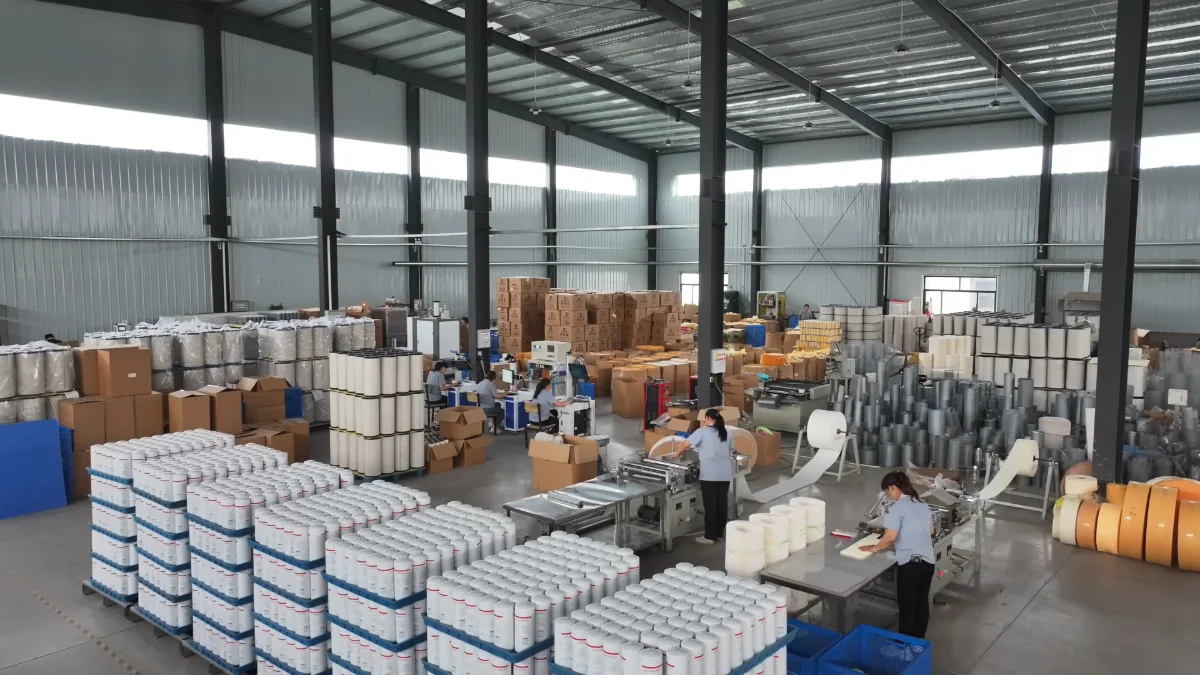
At IXIN Filter, we manufacture air filters, oil filters, fuel filters, cabin air filters, and air dryers for heavy-duty trucks, construction equipment, and agricultural machinery. Every batch of filter media is quality-checked before production, and our filters are cross-referenced against major OEM specifications — not just matched by part number — so distributors and fleet managers can apply the steps above with confidence.
Whether you’re sourcing air filters for a growing fleet or evaluating a new supplier for the first time, we’re glad to share testing documentation and walk through our quality control process.
Want help choosing the right air filter for your fleet? Contact IXIN Filter to request a product catalog or quote.