OEM vs Aftermarket Fuel Filters: 5 Proven Factors to Help You Decide
The OEM vs aftermarket fuel filters question carries a bit more weight than the same debate over other filter types, because fuel filters sit directly upstream of high-pressure injection components that are expensive to repair and unforgiving of contamination. That said, “OEM” and “aftermarket” still aren’t quality ratings on their own — they describe who manufactured the part and its relationship to the original vehicle or engine maker, not a guarantee of performance either way.
Rather than treating this as a simple either/or choice, it’s more useful to look at the specific factors that determine whether a given fuel filter — OEM or aftermarket — is actually right for your application. Here are five that matter most.
1. What “OEM” and “Aftermarket” Actually Mean for Fuel Filters
OEM fuel filters are either manufactured by the vehicle or engine maker directly, or produced under contract to their exact specification and sold under their brand. Aftermarket fuel filters are made by independent manufacturers to fit the same application, without the original brand name attached.
This distinction matters less than people assume, because many aftermarket manufacturers build filters to OEM-equivalent or OEM-exceeding specifications — and in some cases, the OEM-branded part itself is manufactured by a third-party supplier under contract. The label on the box doesn’t automatically tell you which filter performs better.
2. Filtration Performance Should Be Verified, Not Assumed
For fuel filters specifically, the real question isn’t OEM vs. aftermarket — it’s whether the specific filter has documented filtration performance, including Beta Ratio data from multi-pass testing under ISO 19438 (the standard built for diesel and petrol fuel filter testing). A Beta Ratio of 2 only captures about 50% of particles at a given size, while a Beta Ratio of 75 captures roughly 98.7% — two filters can carry the same micron rating on a spec sheet while performing very differently in practice. A quality aftermarket filter tested against these benchmarks can match OEM performance closely; one that’s only matched by outer dimensions can leave your fuel system meaningfully underprotected.
3. Water Separation Capability Deserves Extra Scrutiny
Diesel fuel filters in particular often need to handle water separation alongside particulate filtration, and this is an area where aftermarket quality varies widely. Modern high-pressure common rail systems are highly sensitive to water contamination — even small amounts can damage injector components over time. When comparing OEM and aftermarket options, ask specifically about water-removal efficiency and hydrophobic media design, not just particulate filtration numbers.
4. Cost Differences Reflect Different Things
Aftermarket fuel filters are often priced lower than OEM-branded equivalents, and that gap can come from a few different sources depending on the manufacturer:
- Lower brand and distribution markup, with comparable underlying manufacturing quality
- Genuinely lower-cost raw materials or looser quality control, which can translate into real performance gaps
- Less investment in testing and certification, affecting what documentation a supplier can actually provide
Price alone doesn’t tell you which of these applies — that requires looking at a specific manufacturer’s test data and quality control practices, not the price tag in isolation.
5. Availability, Consistency, and Injector Protection Risk
For high-pressure common rail engines, an underperforming fuel filter doesn’t just mean reduced efficiency — it can mean expensive injector damage, since these systems are engineered around extremely tight tolerances. This raises the stakes on filter consistency more than it does for, say, an air filter. Aftermarket manufacturers with strong batch-to-batch quality control can be a perfectly reliable choice here, but this is a category where verifying supplier consistency matters more than usual, since the downside of a bad batch is a costlier repair than most other filter types.
What This Means in Practice
For most maintenance outside the original warranty period, the practical decision comes down to whether a specific aftermarket fuel filter has verifiable Beta Ratio and water-separation test data — not whether “aftermarket” as a category is inherently riskier for fuel system components. A well-tested aftermarket filter from a manufacturer who can document filtration efficiency and consistent quality control is often a safer choice than an OEM-branded filter you can’t get quick documentation on, and vice versa.
Questions Worth Asking Any Fuel Filter Supplier — OEM or Aftermarket
- Can you provide Beta Ratio or multi-pass test data (ISO 19438) for this specific filter?
- What’s the water-separation efficiency rating, and how is it tested?
- How is dimensional and sealing accuracy verified during production?
- Can you provide samples for independent testing before a bulk order?
- What’s your quality control process for maintaining consistency across production batches?
A supplier who answers these clearly is a stronger signal of quality than the OEM or aftermarket label on its own.
Aftermarket Fuel Filters Built to OEM-Equivalent Standards
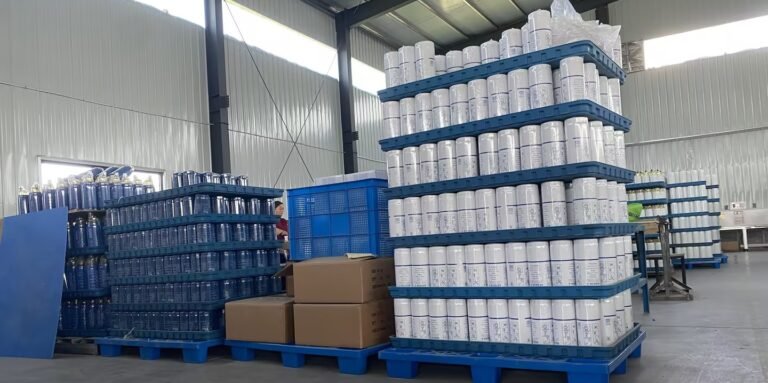
At IXIN Filter, we manufacture aftermarket fuel filters in our IATF 16949-certified facility, engineered to match or exceed OEM filtration specifications — not just OEM physical dimensions. Every batch of filter media is tested before production, and we’re glad to share Beta Ratio testing documentation and samples with distributors evaluating fuel filter quality for their own supply chain.
Want to see how our fuel filters compare to OEM specifications? Contact IXIN Filter to request a sample or product catalog.