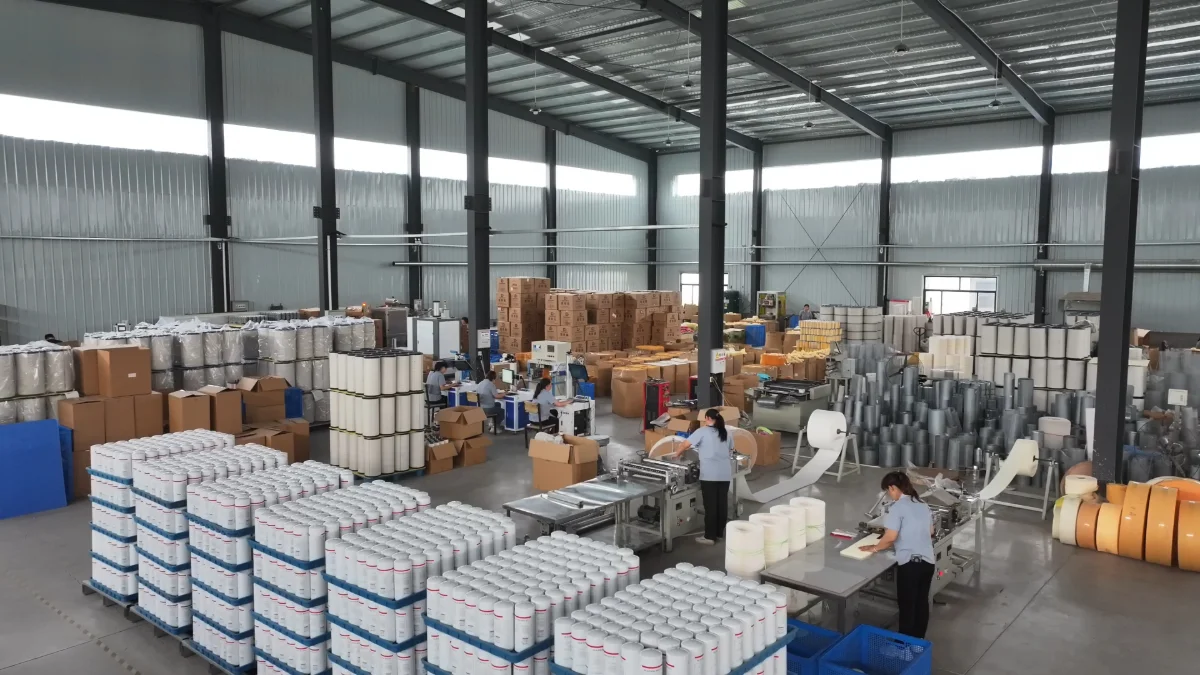
Buying truck filters in bulk looks like a simple way to save money: a lower price per piece, fewer purchase orders and fewer shipments to manage. But the unit price is only one part of the cost. Every filter that sits on a shelf ties up cash, takes up space and risks becoming slow stock. Done without a plan, buying truck filters in bulk can raise your total cost instead of lowering it. This guide covers SKU management, order size, stock turnover and replenishment rules, so you can buy truck filters in bulk and still keep inventory costs under control.
Why Buying Truck Filters in Bulk Can Raise Your Costs
A bulk discount lowers the purchase price, but it also raises your average stock level. Holding that stock has a cost, and the cost grows the longer a filter waits to be sold. For truck filters in bulk, three problems appear again and again:
- Too many part numbers. Heavy duty filters come in a very wide range of models, and every extra model needs its own stock.
- Slow movers hidden among fast movers. A few models sell every week, while many others sell a handful per year.
- Long lead times. Imported stock takes weeks to arrive, which pushes buyers to order large quantities “just in case”.
The steps below deal with each of these problems in turn.
Step 1: Know the True Cost of Holding Stock
Inventory carrying cost is the total cost of holding stock, shown as a percentage of inventory value per year. It combines the cost of the money tied up, storage and handling, insurance and administration, and the risk that stock loses value through damage, shrinkage or obsolescence. Benchmark summaries often cite a range of 20% to 30% of inventory value per year, and other sources point to a similar range. The real figure depends on your cost of capital, your warehouse costs and your risk of write-offs, so calculate your own.
The formula is simple:
Carrying cost % = (capital cost + storage cost + service cost + risk cost) ÷ average inventory value × 100
Capital cost is often the largest part, not storage. That is why a pallet of slow-moving truck filters in bulk costs more than it appears: even if the warehouse space is free, the money tied up in it is not.
Step 2: Sort Your SKUs With ABC Analysis
ABC analysis ranks items by their annual sales or consumption value and splits them into classes. A small share of items, commonly about 20%, produces most of the value, while the largest group of items contributes only a small share. A business can set class limits such as 20% of items for class A, 30% for class B and 50% for class C. The exact numbers vary, so use your own sales data.
Apply it to truck filters in bulk like this:
- Class A (fast sellers): buy regularly, hold safety stock, and keep a close eye on levels.
- Class B (steady sellers): order on a fixed cycle with moderate stock.
- Class C (slow sellers): hold minimal stock, or order only when a customer asks.
Review the ranking every quarter, because items move between classes as demand changes. Our guide on which truck filter models US distributors should stock helps you identify your likely class A models by engine platform.
Step 3: Cut SKU Count Without Losing Sales
Fewer SKUs usually means less stock, and you can reduce the count without turning customers away:
- Use cross references. One aftermarket part number can replace several brand numbers. If three catalog numbers point to the same filter, stock one. Our filter cross reference guide explains how to check a match.
- Verify before you merge. Compare dimensions, threads and seals so that you never merge two filters that only look alike.
- Sell service kits. A kit that combines oil, fuel and air filters for one engine turns three slow orders into one larger sale.
- Drop the dead models. If a model has not sold in a long time and no customer is asking for it, stop reordering it.
- Hold C items as special orders. Quote a lead time and order when the customer commits.
Your product range should shrink where demand is thin and stay deep where demand is strong. Our article on building a profitable truck filter product line covers how to plan a range around your customers.
Step 4: Size Your Bulk Orders by Total Cost, Not Unit Price
Compare order sizes using the full cost: purchase price, freight, carrying cost and the risk of unsold stock. Here is an illustration with made-up numbers, so replace them with your own:
- A class A filter sells 1,200 pieces a year and costs $20.
- Option A: order 300 pieces four times a year. Average stock is about 150 pieces, worth $3,000. At a 25% carrying cost, holding it costs $750 a year.
- Option B: order 600 pieces twice a year at a 5% discount ($19 each). Average stock is about 300 pieces, worth $5,700, so holding it costs about $1,425 a year. The discount saves $1,200 a year.
In this example Option B costs $675 more to hold but saves $1,200 on price, so it comes out ahead by about $525 a year before freight differences. If the filter were a slow seller, the same discount could easily lose money, because the stock would sit much longer and the risk of write-offs would rise. Bulk discounts pay off mainly on fast-moving models. Always add freight, customs and the chance of unsold stock to the comparison.
Step 5: Track Turnover and Days of Inventory
Two numbers show whether your stock is working for you:
- Inventory turnover = cost of goods sold ÷ average inventory.
- Days of inventory = 365 ÷ turnover. This is the average time stock sits before it sells.
Track both for your whole range and for each class. If your class A models turn quickly but your class C models drag the average down, the fix is clear: cut the slow stock. If everything turns slowly, your bulk orders are too big or your range is too wide. Measure every quarter, and compare the figure with your own history instead of someone else’s benchmark.
Step 6: Set Reorder Points and Safety Stock
A reorder point tells you when to place the next order. The basic formula is reorder point = average daily usage × lead time + safety stock, where safety stock is the buffer for demand or delivery delays.
An example with illustrative numbers:
- Average daily usage: 4 pieces
- Lead time (production, sea freight, customs and delivery): 60 days, so lead time demand is 240 pieces
- Safety stock: 20 days of usage, or 80 pieces
- Reorder point: 240 + 80 = 320 pieces
When stock for that model falls to 320, you place the next order. Keep these points in mind:
- Calculate reorder points for class A and B models and update them when sales or lead times change.
- Use realistic lead times that include shipping and customs, not just the factory’s production time.
- Keep safety stock small for slow models and larger for fast models that cost you sales when they run out.
- Many distributors place orders on a fixed monthly or quarterly cycle for class B items instead of tracking each one.
Step 7: Work With Your Supplier on Order Size and Lead Time
Your supplier can help you reduce the stock you need to hold. When you plan an order of truck filters in bulk, ask about:
- MOQ per model and for mixed orders. Mixed orders of several models let you add range without overbuying one number.
- Lead time for stock items and made-to-order items. At IXIN, in-stock items usually ship in 5 to 10 days, and made-to-order items take 15 to 45 days, depending on quantity. Add shipping and customs on top.
- Split shipments. Receiving part of a large order early and the rest later can reduce your peak stock.
- Packaging and labels. Clear part numbers on every carton save handling time and reduce picking errors. If you plan your own brand, see our guide to private label truck filters.
- Quality consistency. A bad batch of a filter you bought in volume costs far more than a few percent of price. Our article on how high-quality filter paper improves truck air, oil and fuel filter performance explains what to ask about media.
Share your sales forecast with the supplier so that production and shipping can be planned around your real demand.
What to Do With Slow-Moving and Dead Stock
Even with good planning, some stock will stop selling. Deal with it early, because carrying cost keeps growing:
- Identify it. Flag any model with no sales for a set period, such as six or twelve months, based on your own turnover.
- Check for fit problems. Make sure the model is not stuck because of a wrong cross reference or a missing application.
- Bundle or discount. Add it to kits or offer it to workshops at a reduced price.
- Stop reordering. Remove it from your reorder list so the problem does not repeat.
- Record the lesson. Note why it did not sell, and use it when selecting new models.
Common Mistakes When Buying Truck Filters in Bulk
- Buying on unit price alone, and ignoring carrying cost, freight and write-off risk.
- Applying one reorder rule to every model, instead of treating fast and slow sellers differently.
- Merging cross references without checking dimensions, which causes returns.
- Underestimating lead time, which leads to stockouts or panic orders.
- Never reviewing sales, so slow stock builds up quietly.
- Putting all the money into one big order, with no room to react to demand.
FAQ
Q: How large should an order of truck filters in bulk be?
A: It depends on demand, lead time, price breaks and your cost of holding stock. Fast-selling models can justify larger orders, while slow models should be ordered in small quantities.
Q: How much safety stock do I need for truck filters in bulk?
A: Hold enough to cover the variation in demand and delivery time for each model. Keep it larger for fast sellers where a stockout costs sales, and small for slow sellers.
Q: How can I find slow-moving models quickly?
A: Rank your models by annual sales value, use ABC analysis, and list any model without recent sales. Review the list every quarter.
Q: Can I buy mixed models in one order?
A: Many suppliers allow it, but the rules differ. Get in touch with us for MOQ and mixed-order options on the models you need.
Q: What are IXIN’s lead times?
A: In-stock goods generally ship in 5 to 10 days, and made-to-order items take 15 to 45 days, depending on quantity. Shipping and customs time is extra.
Q: Does IXIN support custom packaging for bulk orders?
A: We support customized packaging, filter paper quality and metal thickness. Contact our sales team with your requirements.
Planning to buy truck filters in bulk? Send us your model list, expected monthly volumes and target market, and we will reply with specifications, MOQ options and a quotation. You can also browse our air filters, oil filters and fuel filters.
Email: sales@ixinfilters.com | WhatsApp: +86 18833443345 | Get a quote